
Academics & Curriculum
Rigorous classical learning with a strong Christian worldview, cultivating thoughtful and articulate graduates.
A Seven-Year Middle/High School Program
Students in grades 6–12 follow a comprehensive curriculum that integrates Bible and theology, Great Books and humanities, writing, rhetoric and logic, mathematics and science, fine arts, and life skills.
Each year builds on the previous one, guiding students toward intellectual maturity and Christian wisdom.
Bible & Theology
Scripture and Christian doctrine form the center of our curriculum. Students study the storyline of the Bible, core beliefs, apologetics, and integration of faith with everyday life.
Humanities & Great Books
Students read significant works from history, literature, theology, and philosophy, evaluating them through a Christian worldview integrated with history and geography.
Writing, Logic & Rhetoric
Students develop strong writing through frequent essays, study logic for clear reasoning, and rhetoric for persuasive communication. Seniors complete a thesis and public presentation.
Mathematics & Science
Courses emphasize logical reasoning, problem-solving, and wonder at God’s created order. Students progress through algebra, geometry, biology, chemistry, physics, and advanced electives.
Fine Arts
Because beauty reflects God’s character, students engage in music, visual arts, and creative disciplines, developing discipline, creativity, and appreciation for craftsmanship.
Senior Thesis
By graduation, students complete a senior thesis project and present their work publicly, demonstrating mastery of clear thinking and persuasive expression.
"Whatever you do, work heartily, as for the Lord and not for men."
— Colossians 3:23Our Four-Fold Curriculum
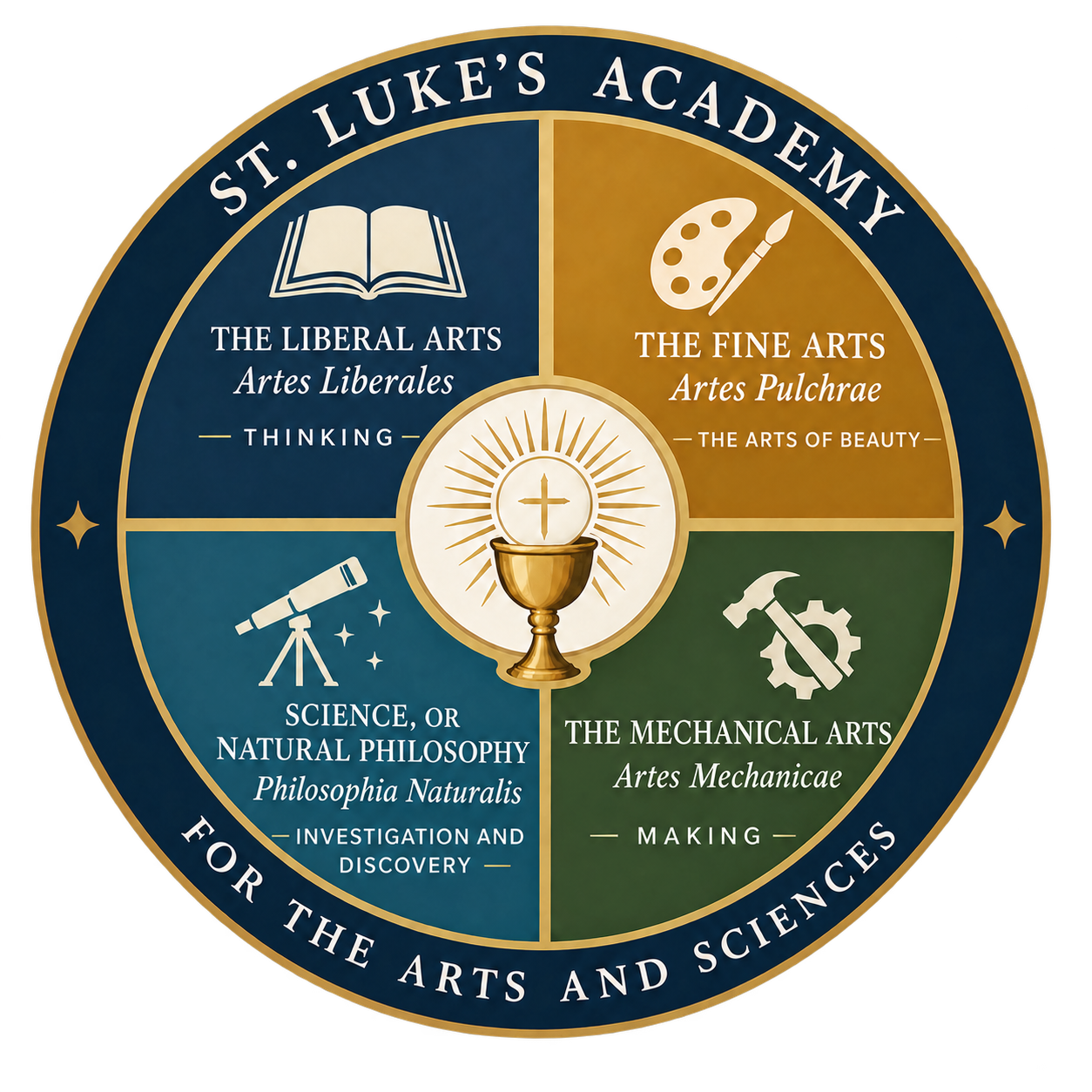
At St. Luke's Academy for the Arts and Sciences, we believe that every truth, every beauty, and every honest work finds its source and its end in God, our Creator. Our curriculum brings together four integrated streams of learning, rooted in the great tradition of Catholic and Western education. Guided by Christ, we pursue wisdom, beauty, and craftsmanship as acts of love toward God.
The Liberal Arts
THE TRIVIUM AND QUADRIVIUM
At the heart of our academic life are the liberal arts, the arts of the free person ordered toward wisdom and eloquence. Through grammar, logic, and rhetoric, students learn to read carefully, reason clearly, and speak persuasively. Through arithmetic, geometry, music, and astronomy, they discover the mathematical harmony woven into creation. The liberal arts form the intellectual foundation on which all learning is built.
The Fine Arts
THE ARTS OF BEAUTY
Through drawing, painting, sculpture, music, and the study of great works, students learn to perceive, appreciate, and create beauty. The fine arts cultivate disciplined perception and thoughtful expression, helping students see and respond to the beauty of creation. We pursue these arts because God is Beauty itself and has made us to delight in it.
The Sciences
THE STUDY OF CREATION
Our sciences grow naturally from the Quadrivium, applying mathematics to the study of the created world. Students explore the order, measure, structure, and beauty of nature through chemistry, physics, biology, astronomy, and other scientific disciplines. We study creation because both Scripture and Nature reveal the handiwork of God, inviting us to pursue truth with reverence and wonder.
The Mechanical Arts
MAKING, BUILDING & ENGINEERING
The mechanical arts restore the dignity of making, building, and craftsmanship. Through woodworking, design, fabrication, engineering, and hands-on projects, students learn to shape materials toward useful and ingenious ends. In the workshop and maker space, they develop patience, practical skill, and an appreciation for the creative work of their hands.
One Curriculum, Whole Persons
The liberal arts teach us to think. The sciences teach us to understand creation. The fine arts teach us to perceive and create beauty. The mechanical arts teach us to make and build. United under the lordship of Christ, these four streams form one education: a unified pursuit of truth, goodness, and beauty. We seek to form students who become scholars, scientists, artists, and makers, offering every gift back to the Creator from whom all good things come.
What to Expect in the Classroom
Our Classrooms are orderly, respectful, and intellectually engaging student can expect
Substantial reading and writing
Clear expectations for behavior and effort
Thoughtful discussions
Teachers who care deeply about their growth
A Christ-centered learning environment